Saturday, April 4, 2009

Pimply Stress

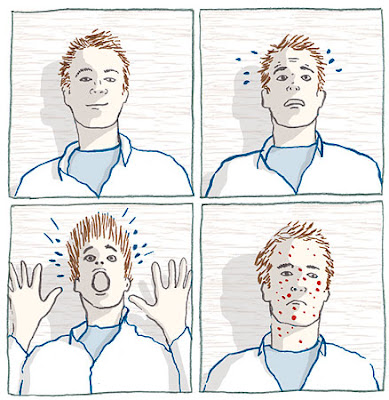
This mini-article on acne and anxiety raises a combo platter of questions relevant to what we're going over in class.

1) Reverse cause & effect: Does acne cause stress, or does stress cause acne?
2) Questionable statistics: Do you trust the stat that students were 23 percent more likely to experience breakouts around the time of a test? Is it a good study? A reliable source? An undemanding stat?
3) Questionable use of statistics: If the above statistic is true, is it reasonable to conclude that anxiety causes acne? Or is there another plausible explanation?
What say you?
Don't Put Too Much Stress On It

Thursday, April 2, 2009

Homework #2

Homework #2 is due at the beginning of class on Tuesday, April 7th. The assignment is to answer problems 1-15 in Exercise 5-1 on pages 110-111 of our textbook. Just tell me what fallacy each argument commits. Don't worry about explaining why the argument commits the fallacy. Also, these arguments don't just commit fallacies from chapter 5. Some commit fallacies from older chapters.

(If you read this, write "Why is anything anything?" at the bottom of your homework to get some extra credit on the assignment.)

Just You Wait, Henry Higgins, Just You Wait

Monday, March 23, 2009

The Source of Satan's Fingers

An anonymous sleuth did some quality googling to discover that "Satan's Fingers" and "The Hospital Bombers" are band names referenced in a Mountain Goats song called "The Best Ever Death Metal Band in Denton." Here's the song:

BONUS! Here is a video of the Mountain Goats performing the song in Philly a year and a half ago:


I was so totally at this concert. Attentive listeners will notice that he changes the name of one of the bands in this video.

Sunday, March 22, 2009

Fallacies, Fallacies, Everywhere

My best friend the inter-net has some nice examples of the fallacy of equivocation. Here are two good ones:

A feather is light.
What is light cannot be dark.
Therefore, a feather cannot be dark.

Margarine is better than nothing.
Nothing is better than butter.
Therefore, margarine is better than butter.
Also, speaking of non sequiturs, here's a cute cat picture:

Did. Not. See. That. Coming.

Wait, we weren't just speaking of non sequit--Oh. I see what you did there.

Clever.

Monday, March 9, 2009

Midterm Rescheduled

So, our schedule says the midterm is this Thursday.

Don't freak out. It's not.

We're pushing the midterm back to Thursday, March 26th.

Sean, You're the Best

Saturday, March 7, 2009

Thursday, March 5, 2009

That's an Ad Hominem, You Jerk

Here's a cartoon on the ad hominem fallacy and hypocrisy. (Click on the comics to enlarge them.)

Hypocrite HippoTofu steaks are bad for statues
Get to studying, you ignorant sluts.

Tuesday, March 3, 2009

Begging the Dinosaur

Here is a comic and a video about the fallacy of begging the question. The first is one of Ryan North's Dinosaur Comics on the fallacy. (Click on the comic to enlarge it)

DOWN WITH DESCRIPTIVISTS IN THIS ONE PARTICULAR INSTANCEAnd here's a special video for Mims's logically delicious song "This is Why I'm Hot":

Sunday, March 1, 2009

Let's Be Diplomatic: Straw Person

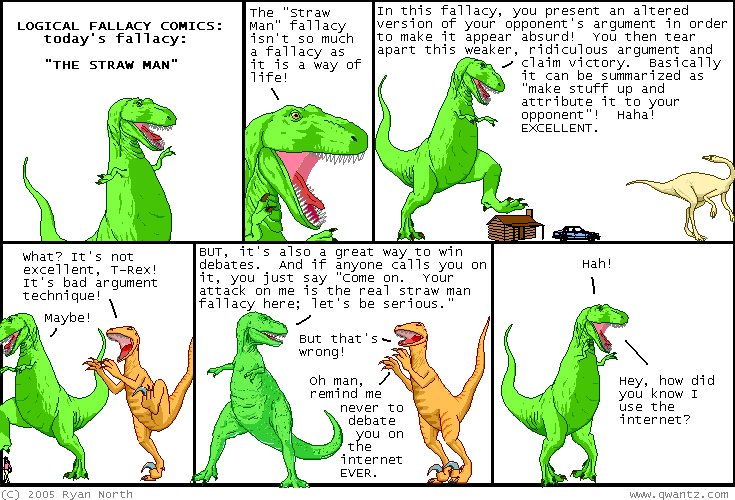
Here's a dinosaur comic on the straw man fallacy (click on the comic to enlarge it):

If I Only Had a Brain...

Saturday, February 28, 2009

Penguin Digestion Experts?

So you didn't believe me when I said that there are experts on the subject of penguin digestion? Oh, you did? Fine, well, I'll prove it to you, anyway. Here are some academic articles on the topic:
Of course, no list would be complete without the often-cited, groundbreaking 1985 Ornis Scandinavica article:
Perhaps my favorite, though, is the following:
If any of these articles are above your head (I think they're all above mine!), you might like this, uh, simpler video demonstration of penguin digestion.

Thursday, February 26, 2009

Consistent as a Contradiction

Here are two videos related to the fallacy of inconsistency:


Let's be charitable, though: is there any way to defend what these seemingly inconsistent people said?

Wednesday, February 25, 2009

An Expert for Every Cause

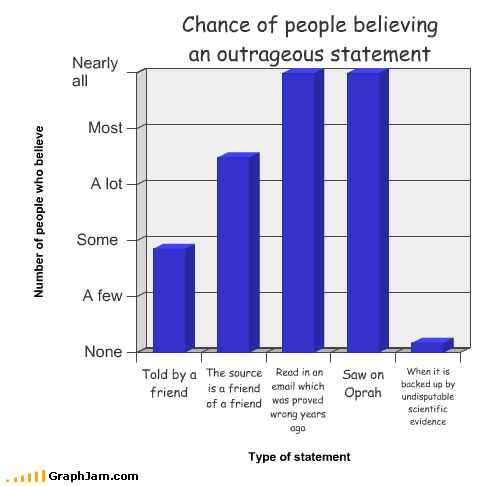
Looking for links on fallacies and appealing to authority? This is your post! First, there's a nice series of short articles on a bunch of different fallacies, including many that aren't in our book.

Next, here's an interesting article on a great question: How are non-specialists supposed to figure out the truth about stuff that requires expertise?

Not all alleged experts are actual experts. Here's a method to tell which experts are phonies.

Here's a Saturday Night Live sketch in which Christopher Walken completely flunks the competence test.

Finally, here's that article on the 9/11 conspiracy physicist that we talked about in class. I've quoted an excerpt of the relevant section on the lone-wolf semi-expert (physicist) versus the overwhelming consensus of more relevant experts (structural engineers):
While there are a handful of Web sites that seek to debunk the claims of Mr. Jones and others in the movement, most mainstream scientists, in fact, have not seen fit to engage them.

"There's nothing to debunk," says Zdenek P. Bazant, a professor of civil and environmental engineering at Northwestern University and the author of the first peer-reviewed paper on the World Trade Center collapses.

"It's a non-issue," says Sivaraj Shyam-Sunder, a lead investigator for the National Institute of Standards and Technology's study of the collapses.

Ross B. Corotis, a professor of civil engineering at the University of Colorado at Boulder and a member of the editorial board at the journal Structural Safety, says that most engineers are pretty settled on what happened at the World Trade Center. "There's not really disagreement as to what happened for 99 percent of the details," he says.
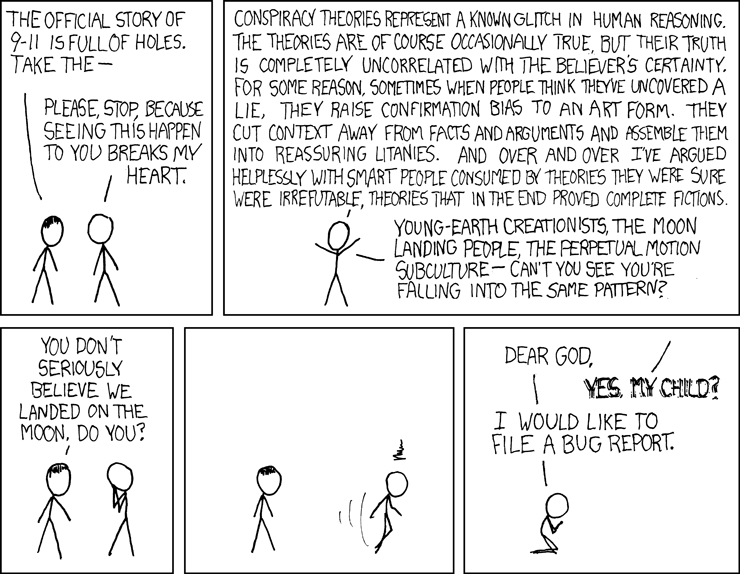
And one more excerpt on reasons to be skeptical of conspiracy theories in general:
One of the most common intuitive problems people have with conspiracy theories is that they require positing such complicated webs of secret actions. If the twin towers fell in a carefully orchestrated demolition shortly after being hit by planes, who set the charges? Who did the planning? And how could hundreds, if not thousands of people complicit in the murder of their own countrymen keep quiet? Usually, Occam's razor intervenes.

Another common problem with conspiracy theories is that they tend to impute cartoonish motives to "them" — the elites who operate in the shadows. The end result often feels like a heavily plotted movie whose characters do not ring true.

Then there are other cognitive Do Not Enter signs: When history ceases to resemble a train of conflicts and ambiguities and becomes instead a series of disinformation campaigns, you sense that a basic self-correcting mechanism of thought has been disabled. A bridge is out, and paranoia yawns below.
There are a lot of graduate-educated young earth creationists.

Tuesday, February 24, 2009

Maybe It'll Taste Good This Year...

Here's some more random stuff related to inductive arguments. First, here's a video of Lewis Black describing his failure to reason inductively every year around Halloween:


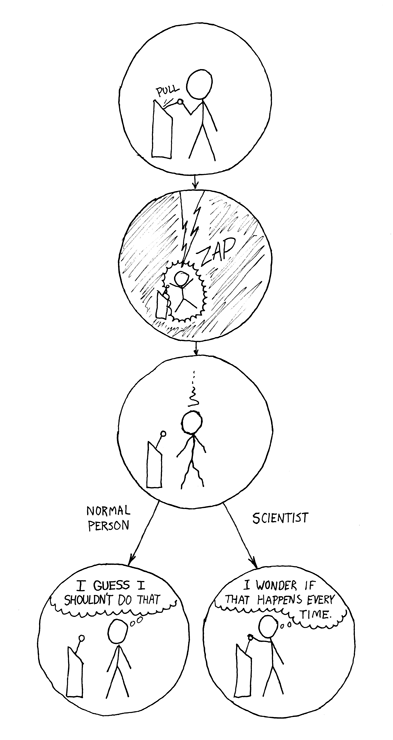
Also, here's a stick figure comic about scientists' impulse to get a big enough sample.

Science: Confirming Induction For As Long As It's Been Unjustified

Sunday, February 22, 2009

Structure

One of the trickier concepts to understand in this course is the structure of an argument. This is a more detailed explanation of the term. If you've been struggling to understand this term, the following might help you.

An argument's structure is its underlying logic; the way the premises and conclusion logically relate to one another. The structure of an argument is entirely separate from the actual meaning of the premises. For instance, the following three arguments, even though they're talking about different things, have the exact same structure:

1) All tigers have stripes.
Tony is a tiger.
Tony has stripes.

2) All humans have wings.
Sean is a human.
Sean has wings.

3) All blurgles have glorps.
Xerxon is a blurgle.
Xerxon has glorps.

There are, of course, other, non-structural differences in these three arguments. For instance, the tiger argument is overall good, since it has a good structure AND true premises. The human/wings argument is overall bad, since it has a false premise. And the blurgles argument is just crazy, since it uses made up words. Still, all three arguments have the same underlying structure (a good structure):

All A's have B's.
x is an A.
x has B's.

Evaluating the structure of an argument is tricky. Here's the main idea regarding what counts as a good structure: the premises, if they were true, would provide good evidence for us to believe that the conclusion is true. So, if you believed the premises, they would convince you that the conclusion is worth believing, too.

Note I did NOT say that the premises are actually true in a good-structured argument. Structure is only about truth-preservation, not about whether the premises are actually true or false. What's "truth preservation" mean? Well, truth-preserving arguments are those whose structures guarantee that if you stick in true premises, you get a true conclusion.

The premises you've actually stuck into this particular structure could be good (true) or bad (false). That's what makes evaluating an arg's structure so weird. To check the structure, you have to ignore what you actually know about the premises being true or false.

Good Structured Deductive Args (Valid)
If we assume that all the premises are true, then the conclusion must also be true for an argument to have a good structure. Notice we are only assuming truth, not guaranteeing it. Again, this makes sense, because we’re truth-preservers: if the premises are true, the conclusion that follows must be true.

EXAMPLES:
1) All humans are mammals.
All mammals have hair.
All humans have hair.

2) If it snows, then it’s below 32 degrees.
It is snowing right now.
It’s below 32 degrees right now.

3) All humans are mammals.
All mammals have wings.
All humans have wings.

4) Either Yao is tall or Spud is tall.
Yao is not tall.
Therefore, Spud is tall.

Even though arguments 3 and 4 are ultimately bad, they still have good structure (their underlying form is good). The second premise of argument 3 is false—not all mammals have wings—but it has the same exact structure of argument 1—a good structure. Same with argument 4: the second premise is false (Yao Ming is about 7 feet tall), but the structure is good (it’s either this or that; it’s not this; therefore, it’s that).

To evaluate the structure, then, assume that all the premises are true. Imagine a world in which all the premises are true. In that world, MUST the conclusion also be true? Or can you imagine a scenario in that world in which the premises are true, but the conclusion is still false? If you can imagine this situation, then the argument's structure is bad. If you cannot, then the argument is truth-preserving (inputting truths guarantees a true output), and thus the structure is good.

Bad Structured Deductive Args (Invalid)
In an argument with a bad structure, you can’t draw the conclusion from the premises – they don’t naturally follow. Bad structured arguments do not preserve truth.

EXAMPLES:
1) All humans are mammals.
All whales are mammals.
All humans are whales.

2) If it snows, then it’s below 32 degrees.
It doesn’t snow.
It’s not below 32 degrees.

3) All humans are mammals.
All students in our class are mammals.
All students in our class are humans.

4) Either Yao is tall or Spud is short.
Yao is tall.
Spud is short.

Even though arguments 3 and 4 have all true premises and a true conclusion, they are still have a bad structure, because their form is bad. Argument 3 has the same exact structure as argument 1—a bad structure (it doesn’t preserve truth).

Even though in the real world the premises and conclusion of argument 3 are true, we can imagine a world in which all the premises of argument 3 are true, yet the conclusion is false. For instance, imagine that our school starts letting whales take classes. The second premise would still be true, but the conclusion would then be false.

The same goes for argument 4: even though Spud is short (Spud Webb is around 5 feet tall), this argument doesn’t guarantee this. The structure is bad (it’s either this or that; it’s this; therefore, it’s that, too.). We can imagine a world in which Yao is tall, the first premise is true, and yet Spud is tall, too.

Good or Bad Structure?

Saturday, February 21, 2009

Satan's Fingers? The Hospital Bombers?

Is That Logic Rock? TURN IT UPOK, before we start rocking all night, perhaps we should come up with a name for our logic band. What's a good name for us? Woodwind-itis?

Hmmm... hopefully, you can come up with better names than that. Post some names in the comments to this post.

(Extra credit to anyone who knows what the title of this post refers to.)